Nesting in dense groups attracts parasites and predators, yet these aggregations persist. The very feature that seems risky creates the system’s complexity.

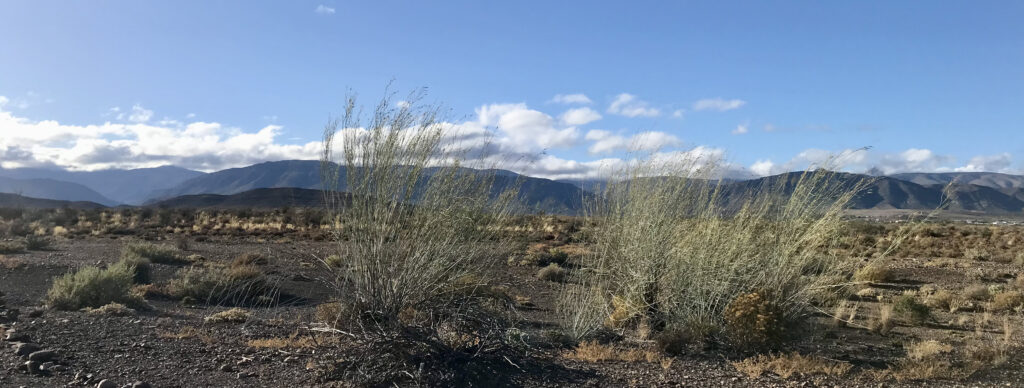
For wild bees, a dry riverbed serves as a natural corridor through otherwise open terrain. Its meandering course offers landmarks to navigate by, riverbanks that shelter from the wind, scattered patches of flowers, and soils with just the right texture for burrowing.

These conditions make it an ideal nesting habitat for species that favour sandy, well-drained ground. In the Karoo, such conditions are common along ephemeral rivers where sand wasps like Bembix dig into the sediment, and for ground-nesting bees, which constitute the majority of solitary bee species globally.
A riverbank is more than a physical feature; it’s a living record of time. Its layers mark past floods and long droughts, changes in vegetation, even ancient climates. In South West Angola, I recently stood before cliffs that revealed stories from a different era, telling of vanished seas, holding fossils of mosasaurs and plesiosaurs in their bone-beds. Here in the Karoo, there are riverbank stories that are still very much alive, written in sand and clay, and unfolding in the form of bees and their intricate communities.
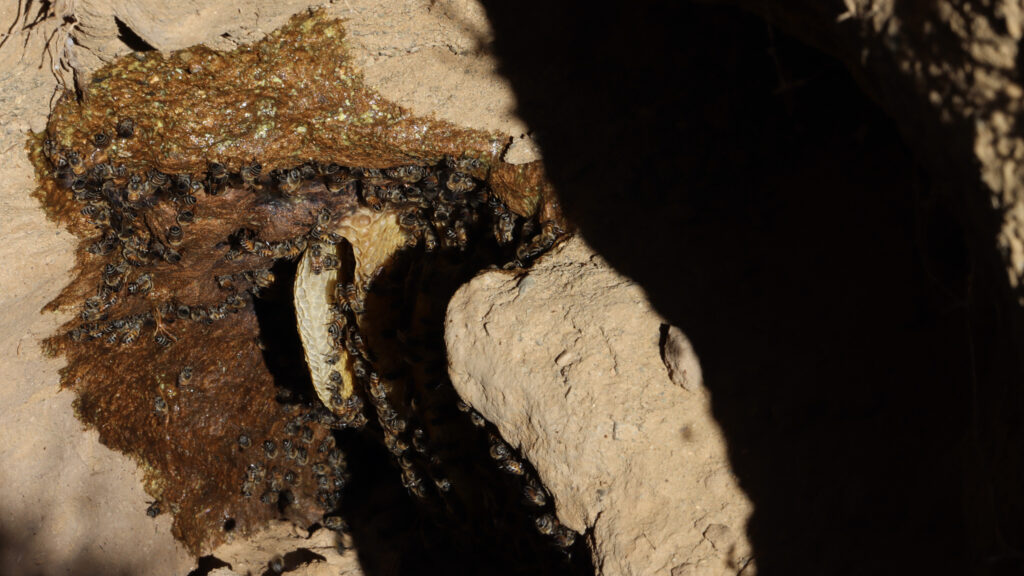
At first glance, a sandy riverbank here looks unremarkable as a sheer wall of compacted earth, a few tufts of grass, roots, the odd shrub, and a scattering of stones. But come closer on a warm spring morning and the surface moves to a low, vibrating hum. Holes dot the bank like pinpricks, and from each one, bees emerge, darting into the air before disappearing again. What seems like just an eroded sandbank is, in fact, a thriving bee aggregation.
Nesting in such dense groups might seem, from an evolutionary standpoint, a bad idea. Parasites and predators quickly notice abundance. Yet these aggregations persist. The very feature that seems risky is what makes the system thrive.
A Spring Awakening


Anthophora wartmanni bees nesting in the river bank
By early September, activity on one such bank at Wolwekraal Nature Reserve is at its peak, continuing through October. It hosts a dense aggregation dominated by Anthophora wartmanni Friese — shaggy, flower-loving digger bees, large-bodied and fast-flying.

The females work tirelessly, provisioning their larvae with pollen and nectar, navigating back to the correct burrow guided by scent. Occasionally one makes a mistake, entering the wrong tunnel before backing out almost immediately, suggesting that each nest carries its own unique chemical signature.
The Anthophora may be the most conspicuous residents, but they are not alone. The same bank also supports populations of Megachile (leafcutter bees), Amegilla, Plesianthidium, and Afroanthidium species, each with slightly different nesting needs and seasonal timing.


Top row (left to right): Anthophora, Megachile, Pachyanthidium.
Bottom: Anthophora wartmanni.
Inside the bank lies a maze. Many burrows branch into two or more tunnels, a network that offers opportunity and danger in equal measure. Parasitic wasps such as the metallic cuckoo wasps (Chrysididae) and the velvet-armoured mutillids use their smaller size to slip between tunnels, entering one hole and emerging from another. The larger bees are confined to their own passages, always using the same entrance.


Nest entrance holes in the riverbank, some with several passages branching from the main tunnel.

Male bees of several species patrol the bank, flying back and forth in search of emerging females. It’s an efficient mate-location strategy and for some species seems better than waiting around at flowers, though it does mean that predators quickly learn where to find them.
The Parasites and Their Strategies
Dense nesting aggregations attract a diverse gathering of parasites and kleptoparasites, each exploiting the concentrated resource of provisioned brood cells.
Velvet Ants


Wingless female mutillid wasp, also shown here dusted with pollen after visiting a bee nest cell.
Among the most conspicuous visitors are the so-called “velvet ants” — female mutillid wasps, wingless, densely hairy, and quick-moving. They scurry over the sand in the midday heat, pausing briefly to inspect a burrow entrance before moving on. Their mission is simple but effective: find a bee’s nest, slip inside, lay an egg on the host’s larva, and leave. The developing mutillid eats the larva and its food supply. Adults, oddly enough, feed only on nectar, a dramatic dietary shift from meat to sugar that would confound most nutritionists.

A female mutillid wasp moves swiftly between the bee tunnels
Male mutillids, in contrast, keep their wings and were often seen inspecting nest entrances, probably in search of emerging females rather than hosts. This strong difference between the sexes, with winged males and wingless females, reflects how each has evolved for a different purpose: males to locate mates and females to locate hosts.

Winged males look into nest entrances, searching for emerging females
Cuckoo Wasps
Then there are the chrysidid wasps, shimmering metallic-green under the Karoo sun. The flashiest of these wasps glitter in brilliant hues of emerald, turquoise and copper. Their colours are structural — microscopic prisms in the cuticle refract light so that even a dead specimen never fades (C. Eardley, pers. comm., 30 September 2025). They slip in and out of bee tunnels, sometimes reappearing some distance away. One pair was seen mating near the bank, suggesting that for the parasites, this place serves as both hunting ground and courtship arena.


Several species of metallic-green cuckoo wasps (Chrysididae).
Cuckoo Bees


Cuckoo bees, including Thyreus and Coelioxys, are also regular visitors. They specialise in parasitising species like Anthophora and Amegilla. Their method differs slightly from that of the wasps: they lay their eggs in completed brood cells, leaving their larvae to consume the pollen store rather than the host larva itself. Either way, the intended offspring loses, with the host larva eventually starving.
Flies


Flies join in with characteristic ingenuity. Bee flies (Bombyliidae) hover near entrances, flicking sand-coated eggs toward burrows. The sand adds weight, propelling the eggs deeper and preventing them from drying out. Once inside, the tiny larva seeks out the host’s brood and parasitises it.
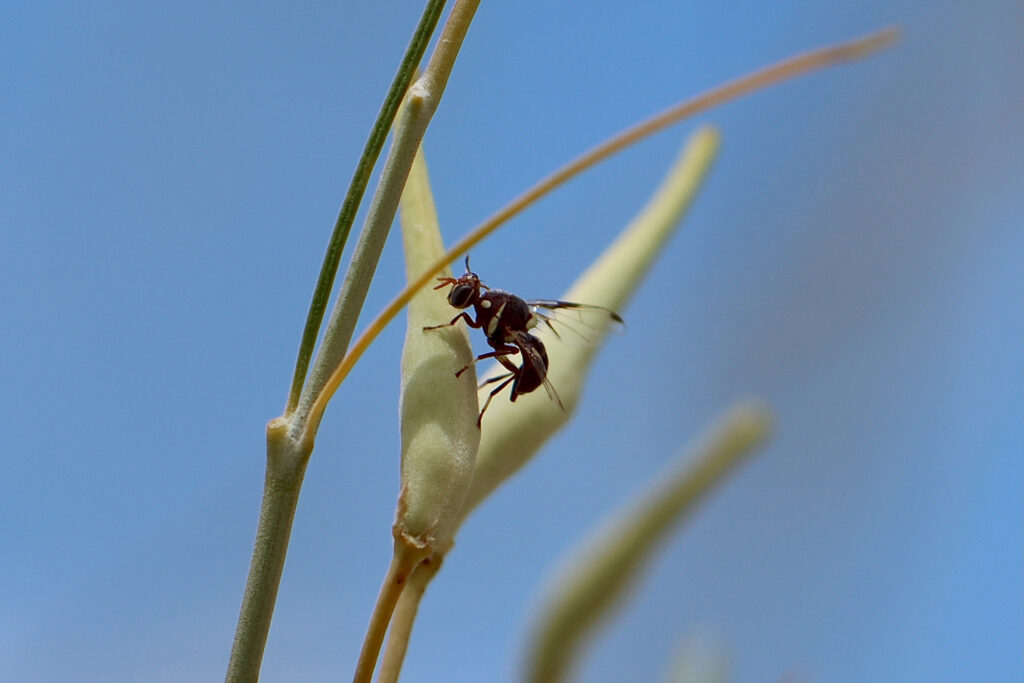
Tachinid flies such as Rondanioestrus apivorus take a more direct approach: their eggs hatch almost instantly, and the larvae burrow into returning bees, developing inside their hosts. Efficiency comes in many forms.


Left: A tachinid fly (Rondanioestrus apivorus) lies in wait on the river bank, watching for returning foragers and, right, flying close to a nest entrance.
Predators and Opportunists
Ants


Ants are part of the story too. Their nests lie directly beneath the bee aggregation, and they emerge late afternoon as temperatures moderate and bee activity declines. Small ant species such as Anoplolepis steingroeveri and the larger, square-headed Tetramorium were observed carrying bee larvae from Anthophora tunnels, possibly scavenging or predating on brood cells damaged during excavation or parasitism. They were remarkably adept at transporting larvae down the steep vertical walls to their nests below. Sometimes their activity caused partial blockages in the bee tunnels, leaving some Anthophora females hovering at the entrances or trapped inside.
Among them, the Balbyter ant was also recorded. Ants likely play a dual role: as opportunistic predators on vulnerable brood and refuse removers, carrying off dead larvae and decaying provisions, like pollen. Their late-afternoon peak in activity minimises direct confrontation with actively provisioning bees.


Other Hunters
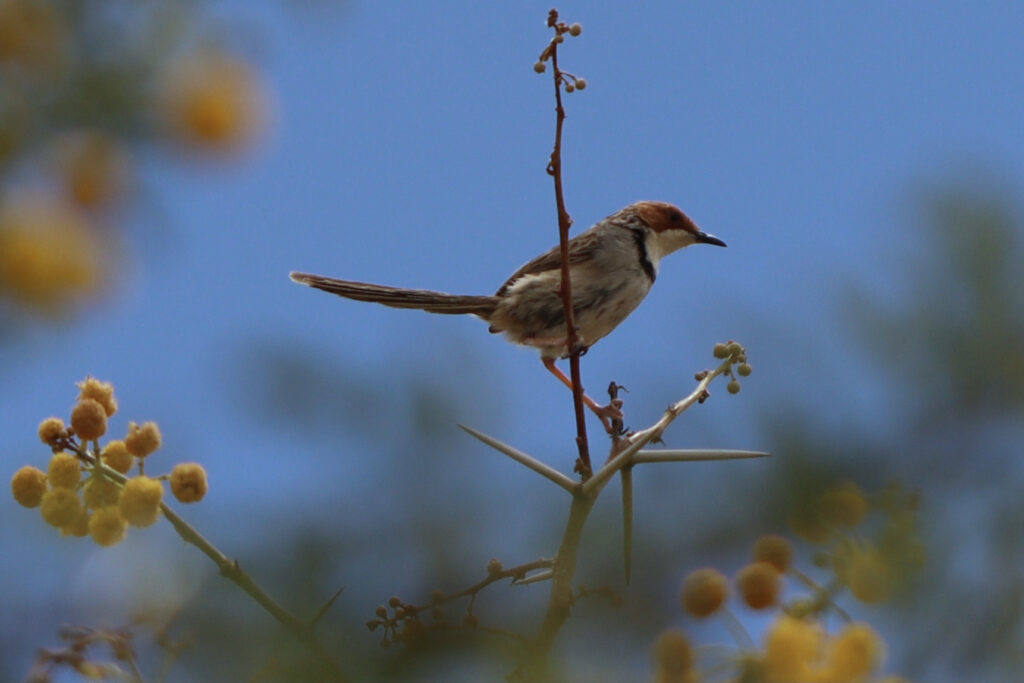
A solifuge, one of the lightning-fast, spider-like sun spiders was spotted nearby. These arachnids can subdue adult bees, though they more often hunt smaller prey. Karoo scrub-robins (Cercotrichas coryphaeus) were also seen foraging along the bank, gleaning ants from the ground, bees from flowers nearby, and scanning the vertical surface for movement. It’s a reminder that vertebrates, too, are part of the system.


Shifts Through the Day


Activity at the aggregation follows the sun. At midday, when the sand is too hot for ants, bees are most active. As the sun lowers, bees retreat, ants emerge, and birds intensify their foraging. This daily rhythm allows many species to share the same narrow strip of habitat without direct competition.
Early in the morning, female bees rest on the sand, absorbing warmth before flying off. It makes them visible to predators, but in the cool Karoo mornings, it’s essential for warming their flight muscles.
A Living System

The more time I spent at this riverbank, the more its complexity unfolded. It’s a place where a diversity of species interact in patterns shaped by millions of years of coevolution. Bees emerge from countless burrows. Parasitic wasps patrol the surface. Flies hover at entrances. Ants appear and become abundant in the late afternoon. Birds scan the sides of the riverbank for movement. The aggregation exists because every element aligns perfectly: the substrate is right, the bank catches the early morning sun, and the site lies within reach of flowers. Change one variable and the system falters. That fragility is what makes biodiversity conservation so complex, and so essential. It’s not enough to save species in isolation; we must protect the very places that make their coexistence possible.
Dry riverbeds and eroded banks like this one are far more than geological features in the Karoo. They are irreplaceable threads in a vast ecological fabric. Edges where life concentrates, adapts, and thrives. In protecting these fragile corridors, we protect the processes that create diversity itself.

Aggregations as Ecological Hubs
Why do bees nest in dense groups when it attracts so many enemies?
When solitary bees nest in dense groups, they face greater risks: parasites, kleptoparasites (like Thyreus), predators, and even competition for space. From the outside, it seems counterintuitive. Why not nest alone, far from danger?
But these dense aggregations also bring key advantages, which is why they persist:
- Safety in numbers: Predators and parasites become diluted across hundreds of nests. Each individual bee’s chance of being targeted decreases.
- Environmental advantages: The bees tend to choose the best microhabitats — in this case, the warm, stable riverbank soils that make nesting and brood development more successful.
- Social cues: Bees can locate suitable sites by following others or detecting the scent of past nesting activity, saving energy and risk in finding a new site.
- Mating opportunities: Males and females find each other more easily around aggregations.
- Evolutionary innovation: The close proximity of many species and individuals fosters complex ecological relationships, from parasitism to species learning how to coexist, that drive adaptation and diversity.
So, what seems risky (high predation and parasitism) is also what creates ecological richness and resilience. The “greatest risk” (clustering together) becomes the “greatest strength” (a dynamic, evolving system that sustains itself through diversity). Aggregations like this function as natural laboratories for studying coevolution, host-parasite dynamics, and community assembly. But they’re also conservation priorities. These systems depend on dynamic landscapes like seasonal flooding, bank erosion, substrate renewal. Stabilising riverbeds or preventing natural erosion eliminates the very processes that create nesting habitat. Understanding solitary bee ecology is urgent as they’re critical pollinators globally, yet far less recognised and studied than honeybees or social species. This dry riverbank, so easily overlooked, teaches us that biodiversity isn’t just about individual species. Rather, it’s about the landscapes that bring communities together and the processes that maintain them.