
Rethinking bees, wildness, and what we’ve forgotten.

Had anyone asked me 11 years ago about bees, I would have said: honeybees live in hives, they make honey, and they’re used for pollination.
That, after all, is the dominant story. The cultural idea of bees as synonymous with hives and honey is deeply ingrained, shaped by books like Maeterlinck’s The Life of the Bee, Kidd’s The Secret Life of Bees, and children’s stories like Winnie-the-Pooh. There are countless such books.
But then I found a wild honeybee nest in a rock crevice.
I lay on the ground, bees flying low over me. I could smell their comb: that rich, floral, tropical-fruit scent of fermentation as enzymes, yeasts and bacteria transformed pollen and nectar into amino acids and sugars. I felt the vibration of their wings and immersed myself in their sounds. That moment marked the beginning of my journey into the largely, and strangely, unexplored world of wild bees, astonishingly overlooked while so much attention has been given to bees in hives.
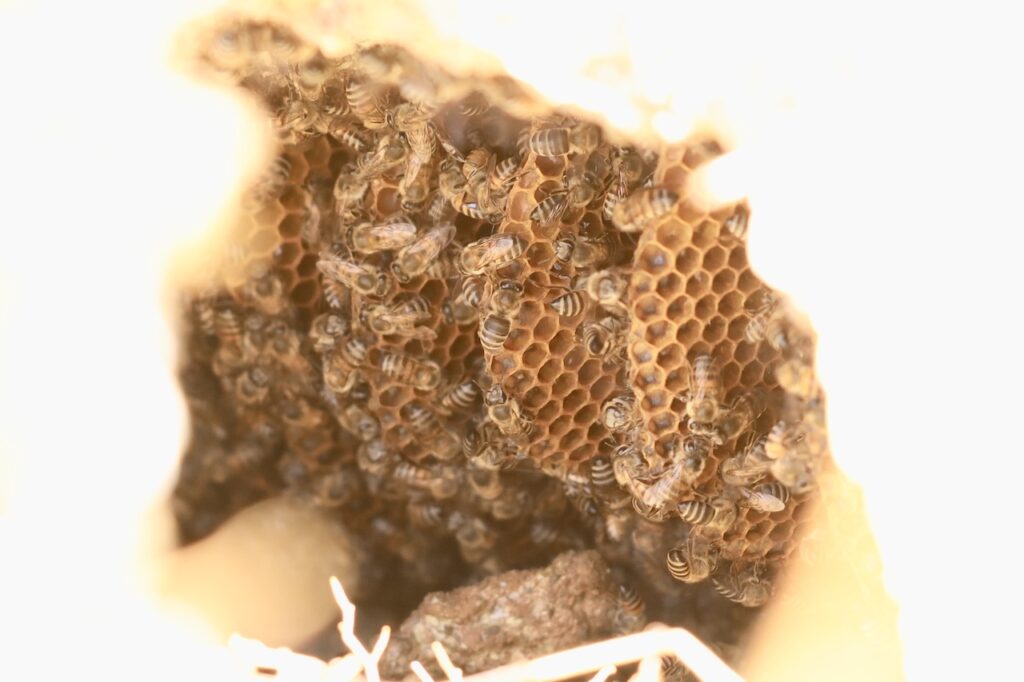
Eleven years later I am still following bees. I feel utterly privileged to be able to study wild-living honeybees and solitary bees here in South Africa. What I have seen has changed me profoundly.
It is an ecological tragedy that in Europe, where honeybees are indigenous and once nested wild in hollow trees, they now exist almost exclusively in hives. In a strange way, the stories told in those old books have become reality. The European wild honeybee has been all but lost. And in places where honeybees are not even native (the Americas, Australia, New Zealand) the vast diversity of local, indigenous bees has been overlooked, eclipsed by the familiar image of the hive.
In fact, the majority of the world’s bees live alone. They dig tunnels in the ground or find other small cavities, each species with its own remarkable nesting strategy, finely tuned to its environment. Some are so specialised that their entire life cycle is bound to a single plant, timed to emerge in perfect synchrony with its flowers.

A rare chalicodoma bee (Megachile taraxia) constructing a mud nest for her young.
My own research has taken me across varied landscapes. It began in the Cape, with its winter rainfall and ancient fynbos, a place of extraordinary botanical richness. But for the past year and a half, I have been immersed in Wolwekraal Nature Reserve, in its Prince Albert Succulent Karoo and Southern Karoo Riviere vegetation types, an arid region just 3km north of the town of Prince Albert.
You might ask: where do bees live in a desert environment?
The more than 40 species of solitary bees I’ve documented at Wolwekraal mostly nest in sparsely vegetated soil patches or in the dry river banks. But honeybees face a different challenge. There are no hollow trees here, and rock cavities are rare. The only real cavities are those dug by aardvarks. In their search for termites, aardvarks burrow into the ground, and it is these abandoned burrows that become homes for wild honeybees.

An aardvark (Orycteropus afer), with its long head, donkey-like ears, and tubular snout.
Since the end of the Karoo’s eight-year drought in 2023, honeybees have returned to the plains, building underground nests that are stunning feats of ecological adaptation.
These nests are not only homes to honeybees but also become small ecosystems. Ants, beetles, wax moths, spiders, and many smaller creatures cohabit with the bees. Honeybees are ecosystem engineers, modifying and shaping environments in ways that benefit other species. And they, too, are food for many.


Ants and honeybees share complex relationships in nature: Common harvester ants (Messor capensis) (left) haul honeybee drones into their nest while sharing the same burrow as a wild honeybee colony, while elsewhere, a Balbyter ant (Camponotus fulvopilosus) (right) carries a dead honeybee back to its nest.
The relationships between bees and plants have blown my mind. Honeybees are meticulous in their choice of flowers, seeking a diversity of pollen and nectar sources to keep their colonies healthy. The resins they gather offer microbial protection and exude essential oils. Solitary bees are just as discerning, visiting flowers not only for food, but also for building materials, scents, and other floral offerings. Some line their burrow walls with the petals of botterblom (Gazania lichtensteinii), others with the leaves of skaapertjie (Lessertia annularis). Still others use plant resin, pulp or secrete a waterproof, cellophane-like membrane. Some even mix a glandular secretion with mud. All of this ingenuity serves a single purpose: to protect their young, sealed in brood cells, sometimes for years, until the rains and the flowers return.


Botterblom (Gazania lichtensteinii) with petals neatly cut by a solitary bee to line the walls of her burrow.

A leafcutter bee (family Megachilidae) carrying a Skaapertjie leaf (Lessertia annularis) to line her burrow.
We have so much to learn from bees.
Having come to know them as wild creatures, intelligent and resourceful, finely adapted to their environments, I can no longer think of bees as simply honey-makers in boxes.
Yet our culture has normalised the idea of using bees “better.” We’ve taken them from their wild homes and stripped them of the diversity of their communities. Wild colonies, once rich in local adaptations, are reduced to pollination tools, to domesticated and managed assets under a homogenised system of beekeeping. We take their food (honey) and replace it with sugar water. (There are so many sweet alternatives to honey!) We expose them to monocultures, drench them in pesticides, and dose them with miticides and antibiotics.
In much of the world we have turned resilience into dependence.
But here in South Africa, and in places like Wolwekraal, we still have wild bees. Not only wild-living honeybees, but also a remarkable diversity of solitary bees, each uniquely adapted to place. This wildness needs fiercely protecting.
We would do far better if we looked to bees not for what we can take, but, as wild creatures, for what they can teach us and what they do to support the huge diversity of our flora.
And so would they.

Braunsapis bee on Rock Barrelwort (Euphorbia heptagona). Over 40 solitary bee species can be found on Wolwekraal Nature Reserve.